Accelerating Science Through Practical, Reproducible Workflows
Scientific progress relies on continuity. Each discovery builds on earlier work, and each advance depends on researchers being able to generate, analyze, and share data with confidence.
In 2025, many laboratories and bioinformatics teams operated under tighter conditions and rising analytical demands. These pressures underscored a fundamental point: research tools must simplify work, support collaboration, and help teams maintain scientific rigor even when resources are limited.
Throughout the year, our focus at Via Scientific was guided by these realities. We partnered with laboratories across academia, biotechnology, and pharma to strengthen the infrastructure that supports complex analyses. Our goal was to make it easier to move from data to insight in ways that are reproducible, transparent, and aligned with everyday scientific practice.
Via Scientific is a young company, founded in 2022 and launched publicly in 2023. The ideas that underpin Foundry were shaped in academic research environments, and this background informed our science-first approach as the platform continued to evolve throughout 2025.
Major Releases and Milestones from 2025
Several important launches expanded what researchers could accomplish with Foundry.
Workbench
We introduced Workbench to give researchers access to scalable cloud computing without the burden of managing infrastructure. This enabled flexible exploratory analysis while maintaining the consistency required for production workflows.
Foundry EDU
Foundry EDU added simple self-service enrollment for academic laboratories, providing immediate access to the full platform. Many academic groups operate with strict administrative and financial constraints, and this release helped them begin running advanced analyses without onboarding delays.
Expanded Workflow and Technology Support
Support grew across metagenomics, single-cell analysis, and spatial biology. Additions such as MetaCAMP, Visium, Visium HD, and Xenium broadened the range of tools researchers could run within a unified environment.
Advisory Team Growth
We welcomed two new scientific advisors, Dr. Stephen Turner and Dr. Shah Nawaz, whose expertise in computational genomics and translational science informed product and strategy decisions throughout the year.
How Foundry Was Used in 2025
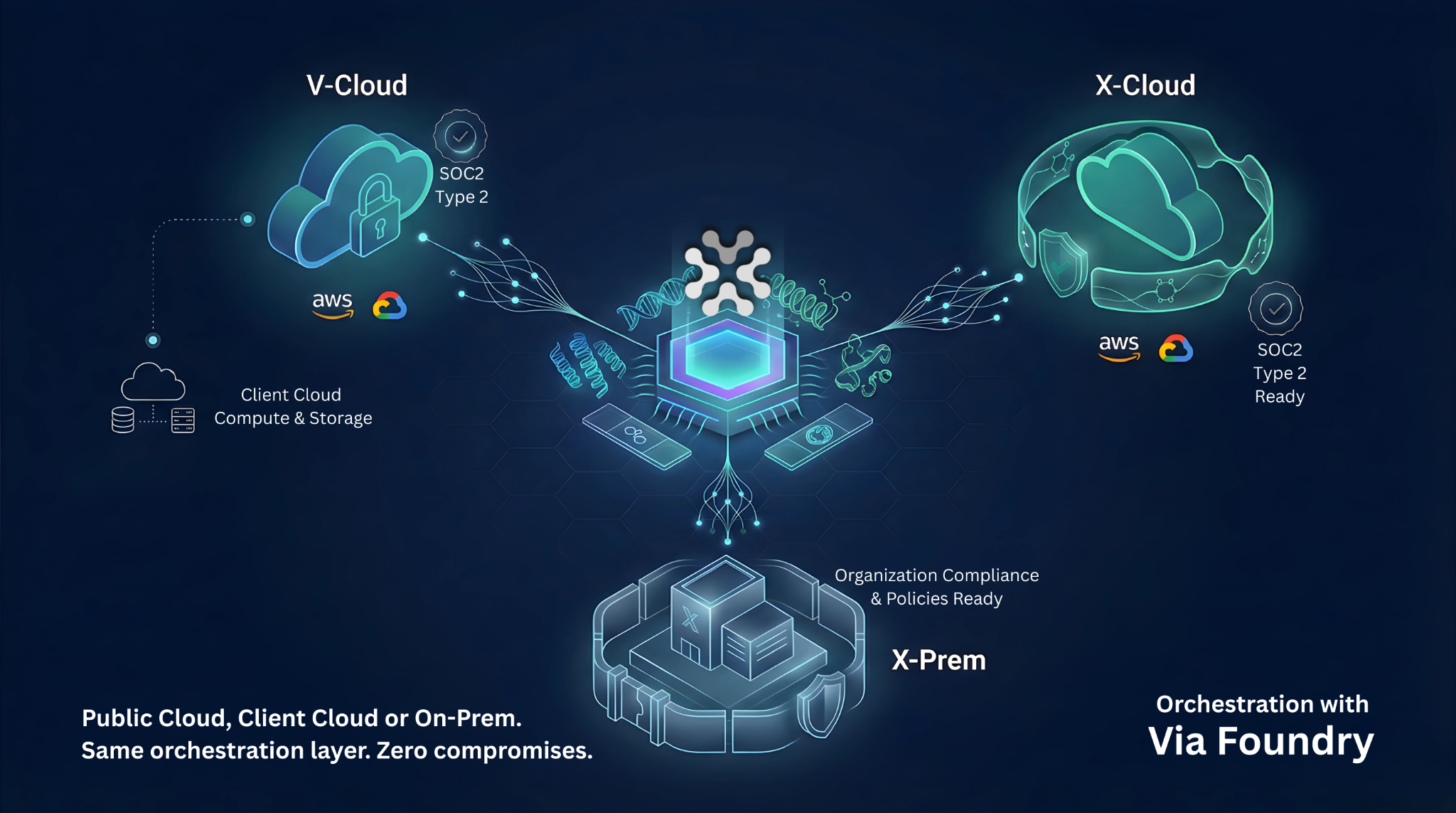
Foundry continued to support research teams across both academic and industry settings throughout 2025. Teams in more than 20 countries used the platform to run analyses across cloud, high-performance computing, and hybrid environments, applying Foundry to both routine and highly customized workflows.
These analyses spanned diverse scientific areas, including cancer genomics, translational research, drug discovery, functional genomics, and population-scale studies. This breadth reinforced the need for a platform that supports both standardized pipelines and flexible exploratory work, depending on the needs of the researcher.
Areas of Improvement Across the Platform
Development work in 2025 focused on simplifying operations, improving collaboration, and strengthening the foundation for reproducible bioinformatics.
Data Ingestion and Workflow Execution
Enhancements to data ingestion, workflow configuration, and execution monitoring shortened the time between receiving raw data and generating results, while reducing the effort required to maintain consistent computational environments.
Results Sharing and Cross-Team Collaboration
We improved features that support shared workflows, consistent pipeline execution, and multi-user visibility. These updates addressed challenges faced by both small research groups and larger teams that coordinate complex analytical work.
Spatial, Transcriptomics, and Custom Workflows
We expanded support for spatial transcriptomics, general transcriptomics, and user-provided pipelines, including nf-core workflows. Many laboratories rely on customized pipelines, and development work focused on making these easier to onboard, version, and reproduce.
Integrated AI for Analytical Insight
To help researchers interpret growing volumes of results, we expanded Foundry’s ability to integrate AI models directly into workflows. These models support tasks such as cross-run comparisons and pattern detection while leaving scientific judgment firmly in researchers’ hands.
User Feedback as a Core Input
Many improvements originated from conversations with teams who use Foundry regularly. Their feedback guided updates to interfaces, metadata handling, execution controls, and workflow design, ensuring changes reflected real analytical needs.
Reproducibility and Research Continuity
Reproducibility remained a central priority for teams working with complex, multi-step pipelines. Foundry’s use of containerized environments helped ensure analyses could be run consistently across machines and computational infrastructures.
We expanded project-level metadata tracking to improve transparency in sample handling, processing steps, and quality assessments, critical for collaborative projects and long-running studies where methods evolve over time.
These efforts reduced the technical and administrative burden of reproducing bioinformatics work, a persistent challenge across the field.
Priorities for 2026
As we move into 2026, research teams face increasingly complex questions, and bioinformatics support must scale accordingly. Our priorities for the year reflect needs consistently expressed by our users. We are working toward improvements in:
- Better tools for organizing and working with experimental context and metadata
- More flexible computing options that align with where data resides
- New capabilities for turning analytical outputs into clearer, more interpretable insights
- Support for emerging technologies across single-cell, spatial, and multi-omics research
- Features that help teams collaborate, review work, and reproduce results with less operational overhead
- Deeper integration of AI models alongside analytical workflows for faster, more confident interpretation
Some of these projects extend work begun in 2025; others will introduce new capabilities throughout the year. All are shaped by ongoing collaboration with our user community.
Looking Ahead With a Science-First Focus
The progress made with Foundry in 2025 reflects the collective efforts of the researchers who use the platform and the feedback they share. We appreciate the trust of the laboratories that rely on Foundry for their work. As we begin 2026, our focus remains on building tools that make complex bioinformatics more accessible, more reproducible, and more collaborative.